PTAC Services in Toronto & the GTA: Repair, Maintenance and Replacement for Hotels and Condos
Published · Updated
One Unit, In the Wall, Doing Both Jobs
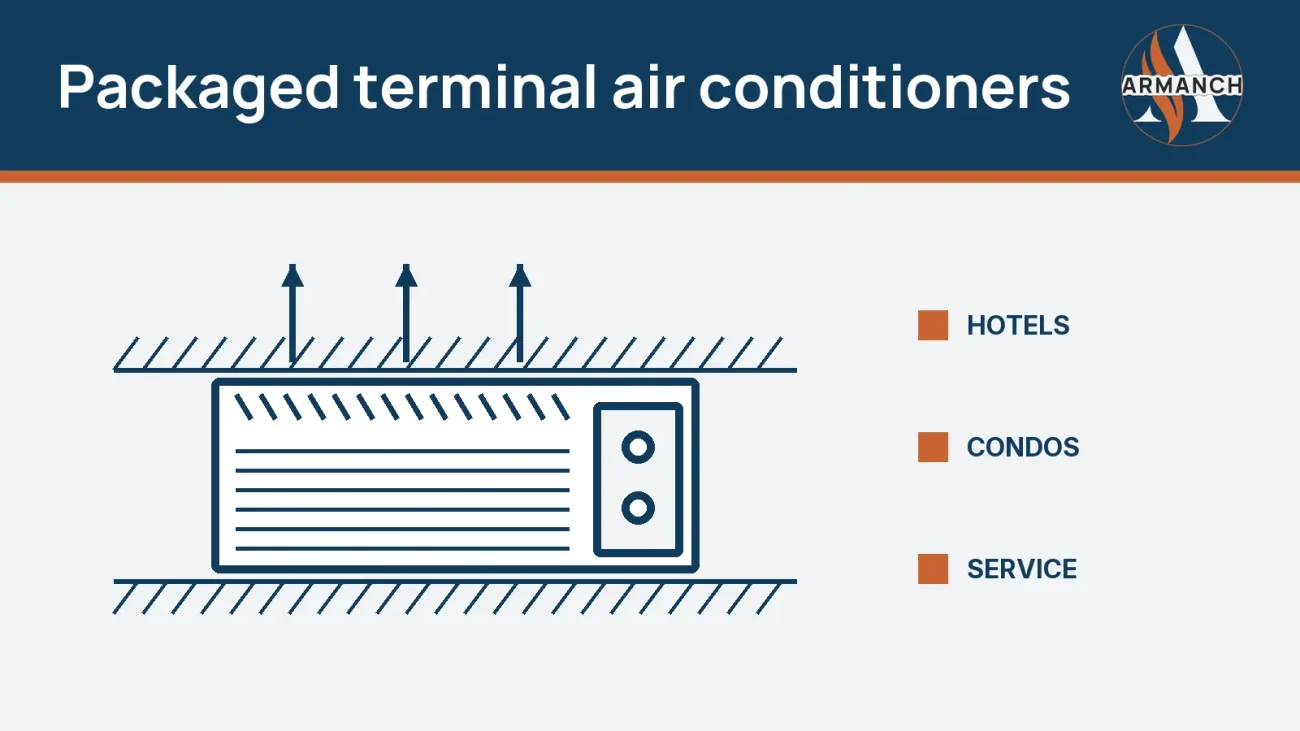
A packaged terminal air conditioner — a PTAC — is a single, self-contained heating and cooling unit that sits in a sleeve set into an exterior wall. Everything is in the one chassis: the compressor, both coils, the fan, the controls and the heating source. There is no separate outdoor unit, no refrigerant lines running through the building, and nothing installed in an attic or a closet. The indoor side delivers conditioned air to the room; the outdoor side, behind the grille on the building’s face, rejects or absorbs heat. That one-box design is exactly why PTACs became the standard in hotel rooms, seniors’ residences, condominium suites, dormitories and small commercial spaces across Toronto and the GTA: each room gets its own unit, its own control, and its own service decision when something fails.
ARMANCH installs, services, repairs, maintains and replaces PTAC units for hotels, seniors’ residences, condominium corporations and individual suite owners across Toronto and the Greater Toronto Area. This page explains how the units are built, what the heating options are, who is responsible for what, and how the repair-versus-replacement decision honestly works.
The Sleeve Is Permanent; the Chassis Is the Unit
A PTAC installation has two parts. The wall sleeve is a metal box set into the exterior wall, flashed and sealed against the weather — it belongs to the building and normally stays for the life of the property. The chassis is the working machine, and it slides into the sleeve from inside the room. That split is what makes PTAC replacement unusually straightforward: in most cases the old chassis slides out and a new one slides in, with no wall work, no refrigerant piping and no renovation. Standard sleeve sizes — 42×16 inches is the most common, with 36×15, 40×15 and 26×16 also in service — mean a replacement chassis has to match the existing sleeve’s dimensions, its voltage and its heating type, which is a selection exercise, not a construction project. We service units from the manufacturers found across GTA buildings, including Amana, Islandaire, Applied Comfort, GE Zoneline, McQuay, Carrier and Perfect Comfort.
Three Ways a PTAC Heats
Cooling is the same refrigeration cycle in every PTAC. Heating is where the variants live. Electric resistance heat is the most common arrangement in GTA condominiums: elements inside the chassis warm the air directly — simple, reliable and entirely the suite’s own system. Heat pump PTACs reverse the refrigeration cycle to heat, usually with electric elements as backup for the coldest weather; they suit buildings looking to move load off other systems, with the same balance-point honesty as any air-source heat pump. Hydronic PTACs carry a hot-water or steam coil fed by the building’s central plant, so the chassis provides the fan and controls while the building provides the heat — in those buildings, a no-heat call can be a plant problem rather than a unit problem, and honest diagnosis has to say which. Gas-fired PTACs exist but are rare in this market, and we will tell you plainly if your building has something unusual.
Who Owns the Problem
In a hotel or seniors’ residence, the answer is simple: the property owns the fleet, and PTAC service is a building programme — planned maintenance across many rooms, repairs on a commercial schedule, and replacement of failed chassis units as part of the property’s capital cycle. In a condominium, the split is different. The in-suite PTAC is typically the unit owner’s responsibility — the chassis, its controls and its upkeep. The sleeve and the building envelope around it, and the central plant behind a hydronic unit, belong to the condominium corporation. We work on both sides of that line, but we will not blur it: if your problem is building-side, we will tell you and put it in writing for your property management, rather than sell you a suite repair that cannot fix it.
What Goes Wrong
PTAC failures are usually unglamorous and diagnosable. Filters and coils foul with room dust until airflow and capacity fall off and the unit runs long and loud. Fan motors and bearings wear. Control boards and thermostats drift or fail, and wall thermostats get replaced with incompatible models that never quite run the unit properly. Electric elements and their sequencers fail in heating season; reversing valves stick on heat pump models; refrigerant leaks show up as a unit that cools weakly and ices in humid weather. Condensate management matters too: a unit that is not draining properly puts water into the sleeve and the wall assembly below it. Because the whole machine is one chassis, most faults can be proven on the spot — the unit slides out, the failed component is identified, and the repair decision is made with the machine open in front of you rather than guessed at over the phone.
Service, and the Repair-or-Replace Line
A proper PTAC service visit pulls the chassis, cleans the coils and blower, replaces or cleans the filter, checks the drain and sleeve condition, tests the heating and cooling modes, and verifies the controls and thermostat against the unit’s actual behaviour. For hotels, residences and condominium buildings we offer maintenance plans built around that scope — a fleet of room units is exactly where planned maintenance earns its place, because failures surface as guest complaints and emergency calls. For an individual suite owner, a sensible service pattern is usually enough, and we will say so.
Our rule is the same as everywhere in our work: repair first, if it makes sense. A failed motor, board, element or control in a sound chassis is a repair. Replacement becomes the honest conversation when the compressor has failed on an older chassis, when refrigerant leaks repeat, or when parts for a discontinued model are no longer reliably available — and because the chassis swaps into the existing sleeve, replacement is often simpler than owners expect. For a complete new unit we install, the ARMANCH labour warranty is a stated fraction of the manufacturer’s parts warranty for that equipment, and the terms are set out in writing before you accept the quotation.
Pricing is published before we start. A PTAC service call to an individual condo suite is a residential call: $130, including travel and the first 30 minutes of work, with additional labour at $110 per hour. Hotels, seniors’ residences and condominium buildings are commercial work: $170 for the call and $150 per hour. Prices exclude HST; standard-rate hours are Monday to Friday, 7 a.m. to 3 p.m. And one rule protects you completely: no diagnosis, no charge. Full terms are on our service pricing page. If your suite’s system is a fan coil rather than a PTAC, our fan coil unit services page covers that equipment.
ARMANCH Inc. provides HVAC-R service, repair, maintenance and installation across the Greater Toronto Area for residential, condominium, commercial and industrial clients. We are also the team behind a patented all-in-one heat pump now in its certification phase — see the campaign: https://fundrazr.com/armanch-hvac