
HVAC service in Old Toronto
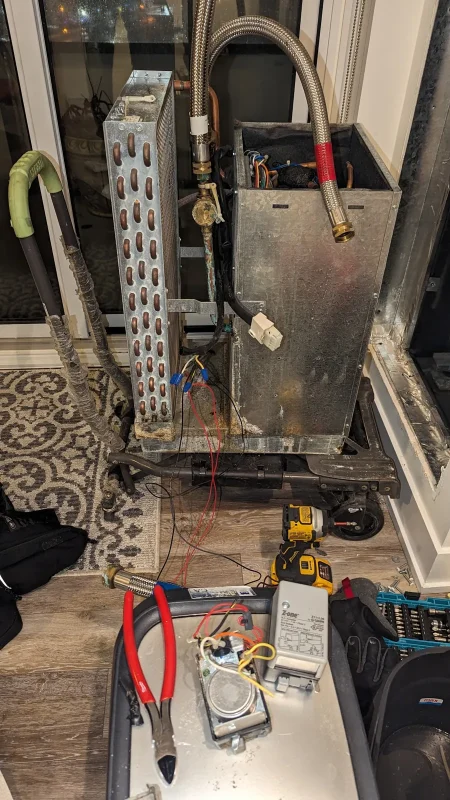
ARMANCH provides HVAC-R diagnosis, repair, maintenance, installation and replacement in Old Toronto, for homes, condominium units, and commercial and industrial properties. Old Toronto is one of the six former municipalities that became the City of Toronto on January 1, 1998, so City of Toronto permits and by-laws apply. Complex mechanical troubleshooting is a service focus.
Buildings and typical HVAC work in Old Toronto
Old Toronto has the city’s oldest housing: Victorian and Edwardian semi-detached and row houses on narrow lots, many converted into flats, beside downtown condominium towers and older commercial buildings with rooftop equipment.
Common problems in these buildings
- Hot-water radiator systems and older boilers that lose pressure, need bleeding or have tired circulators
- Houses with radiators and no ductwork where the owner wants air conditioning
- Shared walls and narrow side yards that limit where an outdoor unit can go
- Fan coil units and through-wall units in condominium suites
We service boilers and radiator systems, install ductless heat pumps where there is no ductwork, maintain fan coil units in condo suites, and service rooftop units on commercial buildings.
Rates: Service pricing & terms.
Old Toronto design temperatures
Equipment is sized from a load calculation that uses the outdoor design values the Ontario Building Code lists for each location. For the old city, SB-1 lists Toronto City Hall:
| SB-1 location | January 2.5% / 1% (heating) | July 2.5% dry / wet bulb (cooling) | Degree-days below 18 °C |
|---|---|---|---|
| Toronto (City Hall) | −18 °C / −20 °C | 31 °C / 23 °C | 3,520 |
City Hall has the mildest winter design value and the fewest heating degree-days of the four Toronto listings in SB-1; the North York, Scarborough and Etobicoke listings use −20 °C. Ask which values the sizing for your address uses.
Wall-mounted air conditioners and heat pumps
Under City of Toronto Zoning By-law 569-2013, clause 10.5.40.60(8)(D), equipment mounted on a residential building wall may encroach up to 0.9 m into a required rear setback, and into a required side setback only if it is no higher than the first storey; in both cases it must stay at least 0.3 m from a lot line. Site-specific exceptions can apply.
Other City of Toronto rules:
- North York: ground-mounted units in front and side yards
- Scarborough: units in rear yards
- Etobicoke: the noise limits
- York: which work needs a building permit
- East York: rooftop equipment and minor variances
Condominium units and shared systems
Tell us whether the problem concerns one occupied unit or a shared building system; shared systems need separate scope review and residential rates do not cover them.
Request service in Old Toronto
Call +1-647-676-7664 (service calls are accepted by telephone 24 hours a day, 7 days a week; a call does not guarantee immediate attendance) or use Ask ARMANCH (the chat) with the equipment type, the symptoms and the property type. We confirm availability and any appointment with you.
Sources (checked 22 November 2026)
- Ontario 2024 Building Code Compendium, SB-1 Climatic and Seismic Data
- City of Toronto Zoning By-law 569-2013, Chapter 10
- City of Toronto Archives: former municipalities
Questions about our services, charges or urgent requests? See the HVAC services FAQ.