Boilers and Combi Boilers Explained: How They Work, the Types, and Repair or Replace
Published · Updated
Two Names, One Job: Heating With Water
A boiler heats a building with water instead of air. The water carries heat from a single plant — in a basement, a utility room or a commercial mechanical room — out to radiators, in-floor loops or coils, and back again. A combi boiler is a boiler that also makes domestic hot water on demand, in the same unit. Between them, boilers and combis heat a large share of Toronto’s older homes, many condominium buildings, and plenty of commercial and industrial spaces across the GTA.
This page is the explainer: how the equipment works, how the types differ, where a combi’s limits honestly sit, and how boiler problems are diagnosed. If you are looking for the service itself — installation, replacement or repair — that lives on our boiler installation and repair page.
How a Boiler Works
A burner heats water inside a heat exchanger. A circulator pump moves that hot water through piping to the emitters — radiators, radiant floor loops, a coil in an air handler, or an indirect tank that stores domestic hot water. The water gives up its heat along the way and returns cooler to be reheated. Controls tie it together: thermostats call for heat zone by zone, and safety devices — pressure relief valves, temperature and pressure controls, flame safeguards — watch the plant while it runs.
Modern boilers modulate: instead of firing at full output or nothing, they turn their burners up and down to match the load. Matched to a correctly sized system, that produces the long, steady, even heating hydronics are known for. Matched to the wrong system — oversized boiler, undersized emitters — it produces short-cycling and complaints, which is why sizing is a calculation and not a guess, as our heat loss and gain explainer sets out.
The Main Types
Conventional boilers heat water and send it out; domestic hot water comes from a separate tank or an indirect tank the boiler feeds. They are the long-standing arrangement in larger homes and commercial plants, where heating load and hot-water demand are both substantial.
Condensing boilers recover additional heat from their own exhaust gases, cool enough that the water vapour in the exhaust condenses — which is why they need a condensate drain and vent through plastic pipe rather than a chimney. Most new GTA installations are condensing units; the venting and drainage realities are covered on the boiler installation and repair page.
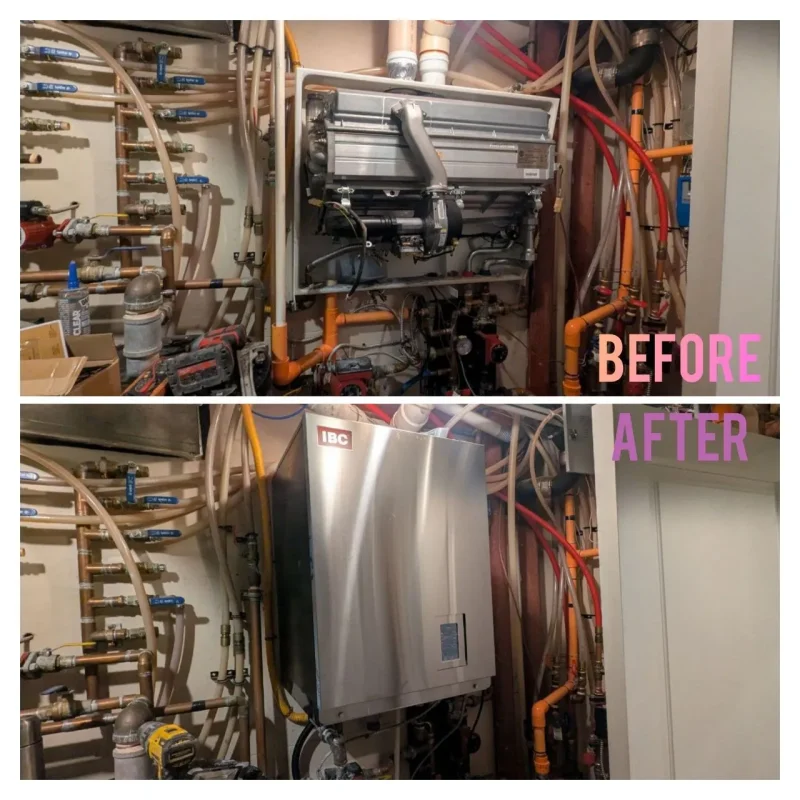
Combi boilers combine space heating and on-demand domestic hot water in one compact unit, with no storage tank. They suit condos, smaller homes and renovations where mechanical space is tight — with one honest limit, covered next.
The Combi Limit Nobody Should Hide
A combi makes hot water at a set flow rate. One shower at a time, it keeps up comfortably. A shower, a filling bath and a running kitchen tap at once can stretch it past what it can deliver, and the water temperature tells you so. That is not a defect — it is the physics of heating water as it flows rather than storing it hot. The right question at selection time is how much hot water your household draws simultaneously, and an honest installer sizes to that answer. Where simultaneous demand is high, a boiler with an indirect storage tank is often the better recommendation, even when a combi is the easier sale. Our guide to the top 5 boiler brands for Canadian homes compares the main makers on both sides of that choice.
What the Boiler Feeds
The boiler is the plant; the emitters decide how the heat feels. Radiators are the classic pairing in older Toronto homes. Hydronic radiant floors run at lower water temperatures and pair especially well with condensing boilers. Indirect tanks store domestic hot water. Snow-melting systems put the same plant to work outdoors. And hot-water coils inside air handlers let one boiler serve forced-air zones too. A fault in any of these can look like a boiler fault — which is why diagnosis looks at the whole loop, and why our heating, hydronics and hot water service covers the system, not just the appliance.
Boiler Problems We Actually See
No heat in one zone but not another usually traces to a zone valve, a circulator or air locked in that loop — not the boiler itself. Pressure that keeps dropping points to a leak, a tired expansion tank or a passing relief valve. Kettling — banging and rumbling from the plant — usually means scale or sludge restricting flow across the heat exchanger. Ignition failures, leaking sections and corroded fittings round out the common list. Each symptom has several possible causes, and the causes live in different places and at different prices. Diagnosis before parts is the only honest order: isolate, test, prove the cause, then talk options. Serious troubleshooting of complex hydronic problems — the intermittent, multi-zone faults that defeat a quick visit — is ARMANCH’s specialty.
Repair or Replace?
Our rule is simple: repair first, if it makes sense. A boiler with a sound heat exchanger and a failed circulator, valve, control or igniter is a repair, and often a straightforward one. Replacement becomes the honest recommendation when the heat exchanger itself has failed or is corroding through, when parts for an older unit are no longer reliably available, or when the repair bill approaches what the boiler’s remaining life can return. We will show you which side of that line your boiler is on, and why — the decision stays yours.
Maintenance, Matched to Need
Boilers earn periodic attention: combustion and venting checks, system pressure and expansion-tank condition, water quality, controls and safety devices. For commercial and industrial plants and condominium buildings — where the plant serves many people and a failure is an event — we offer maintenance plans and service agreements, including planned annual shutdown work coordinated with your team and other contractors. For larger or complex homes, or owners who cannot manage the equipment themselves, a plan can make sense and we offer them on request. For an ordinary small home, we will recommend a sensible service pattern rather than sell a plan out of habit.
Service pricing is published in advance: a residential service call is $130, including travel and the first 30 minutes, with additional labour at $110 per hour; commercial and industrial calls are $170, with additional labour at $150 per hour. Prices exclude HST; standard-rate hours are Monday to Friday, 7 a.m. to 3 p.m.; and the rule is no diagnosis, no charge. Full terms are on our service pricing page, and installation and repair work is booked through the boiler installation and repair page.
ARMANCH Inc. provides HVAC-R service, repair, maintenance and installation across the Greater Toronto Area for residential, condominium, commercial and industrial clients. We are also the team behind a patented all-in-one heat pump now in its certification phase — see the campaign: https://fundrazr.com/armanch-hvac